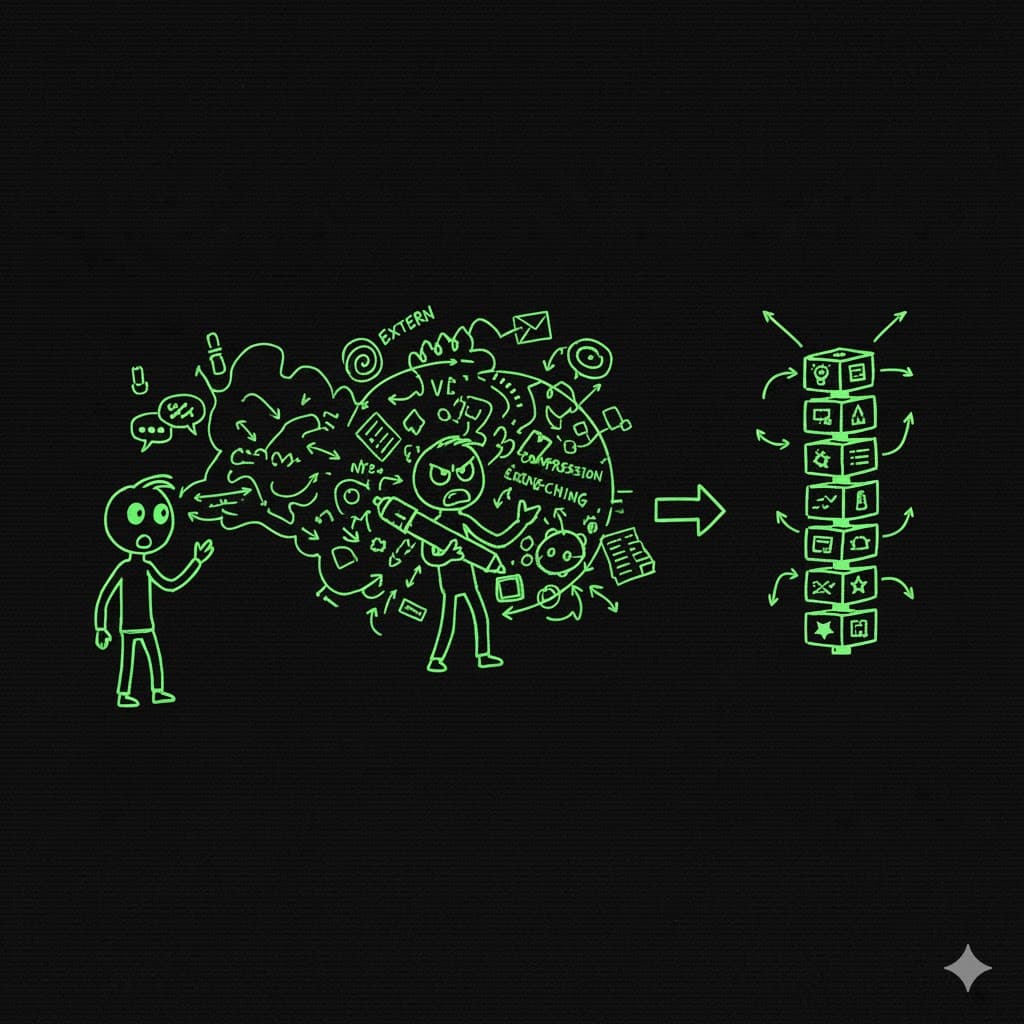
Building your own structured, linkable and evolving knowledge base is the best way to externalise and improve your thinking and research.
The Passive Consumption Trap
We are entering the era of peak 'passive consumption trap'. It's a trap, because there is so much information freely available on the internet - it is becoming increasingly alluring to surface-skim content and feel as though you're really 'learning' stuff. But this isn't real learning, it's an illusion (or 'shortification') of learning.
LLMs make it easier than ever to "feel like you're learning," but most of that is, at best, 'pseudo-learning'. Or worse, LLM-induced cognitive rot.
There are a lot of videos on YouTube/TikTok etc. that give the appearance of education, but if you look closely they are really just entertainment. This is very convenient for everyone involved : the people watching enjoy thinking they are learning, and the people creating enjoy thinking they are teaching. But very little learning is happening. So for those who actually want to learn. Unless you are trying to learn something narrow and specific, close those tabs with quick blog posts. Close those tabs of "Learn XYZ in 10 minutes". Consider the opportunity cost of snacking and seek the meal - the textbooks, docs, papers, manuals, longform. Allocate a 4 hour window. Don't just read, take notes, re-read, re-phrase, process, manipulate, learn.
5:10 AM · Feb 11, 2024 · View on X
The Antidote: Structured Externalisation
The antidote is a structured system to externalise.
To be clear - the process of externalisation is the thing. True learning means taking ideas out of the passive consumption loop.
You can 'externalise' in many different ways - it doesn't need to be a specific tool or method. But it must involve some form of compressing ideas and insights into your own words, linking them to things you already know and storing them somewhere 'outside' your brain.
That somewhere else might be someone else - explain or teach or debate your newly compressed ideas with a friend over coffee, write a blogpost, journal. The more you encode, resurface, change and decode your ideas, the better.
Simple System Examples
There are many great systems and processes for personal knowledge management.
Two examples are Building a Second Brain and the Zettelkasten method.
Building a Second Brain is about storing and transforming information in a trusted external system so your brain doesn't have to hold it all.

Zettelkasten is more about thinking by writing: you create small, self-contained atomic notes in your own words and link them together over time.
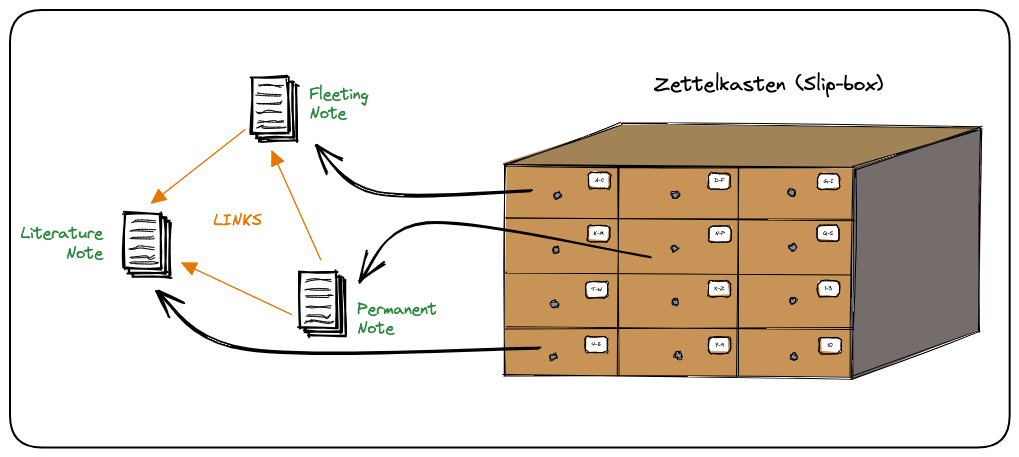
They both, fundamentally (my interpretation anyway) focus on the act of externalising ideas.
Both of these systems/frameworks have inspired 'ra-h'.
The Vendor-Neutral Knowledge Base
The argument I will make here is that you don't need to subscribe to any specific system or process. But - you're leaving a lot on the table if that externalisation doesn't solidify into some persistent and evolving artifact - an external knowledge base.
To be more specific - if you're actually trying to learn something, all the passive raw conversations you're having with language models - ChatGPT, Claude, Gemini, need to be extracted, refined, and stored in your own external management system, which should become your own compounding asset.
It can be any note-taking system or software - Obsidian, Notion, Github, plain Markdown files, it can even be pen, paper and a filing cabinet. Whatever works. Ideally, you're using some kind of system that facilitates searchable, structured, linkable ideas. A system that makes it easy to find connections and build on past insights.
If you're having valuable conversations and not synthesizing them into your own knowledge structure, you're capturing a small fraction of the potential value. You're accumulating information, not transforming your thinking.
What Real Thinking Actually Requires
Effective research and thinking isn't static. It's not about passively absorbing information and hoping it sticks. It involves iteration and effort.
We don't fully understand how memory and continual learning work in the brain, but we know it's not passive storage. It's this process of compacting, extracting, connecting, encoding and decoding.
Continual Learning Explains Interesting Phenomena in Human Memory
Here are some of the required ingredients:
Effortful compression: What am I really trying to say here? What's the core insight?
Active synthesis: How does this connect to what I already know?
Re-encoding: Translating ideas into YOUR framework, YOUR language, YOUR understanding
Compounding: Each insight standing on the shoulders of previous ones
When you have ad-hoc conversations in ChatGPT, Gemini, Claude, or Grok, or even passively read an article or book, or listen to a podcast—and never extract the ideas or insights—you skip most of the important steps. You're outsourcing the exact cognitive work that makes thinking valuable.
The Vendor Lock-In Problem
Language models are wonderful learning assistants. But they won't (and can't) ever be designed to encourage your depth of thinking over general use. This is a muscle you have to exercise yourself.
When you use any of the major providers — ChatGPT, Claude, or Gemini — your conversations live on their servers. The connections you make (how one idea links to another, where a thought came from, how your thinking changed) sit in silicon-stacked server racks somewhere in Virginia, Texas, California, or Washington.
You're far better off storing your data externally.
A Recent Conversation on 'Saying the Thing'
At the end of the recent Dwarkesh ↔ Andrej podcast, they discussed some of these challenges.
Dwarkesh:
"it is in 100% of cases that just the narration or the transcription of how they would explain it to you over lunch is way more, not only understandable, but actually also more accurate and scientific, in the sense that people have a bias to explain things in the most abstract, jargon-filled way possible and to clear their throat for four paragraphs before they explain the central idea. But there's something about communicating one-on-one with a person which compels you to just say the thing. Just say the thing."
Karpathy:
"explaining things to people is a beautiful way to learn something more deeply. This happens to me all the time. It probably happens to other people too because I realize if I don't really understand something, I can't explain it. I'm trying and I'm like, 'Oh, I don't understand this.' It's so annoying to come to terms with that. You can go back and make sure you understood it. It fills these gaps of your understanding. It forces you to come to terms with them and to reconcile them. I love to re-explain things and people should be doing that more as well."
To be clear, there are many ways to increase depth and effectiveness of learning - explaining something to a friend over coffee, writing a blog, even prompting an LLM to question your knowledge on 'x' subject, all fantastic ways to reinforce learning.
But actually synthesizing your learnings to an external knowledge base forces you to do this by default and gives you a second-brain, compounding artifact.
Related: Learn how to connect your favorite chat apps to RA-H and turn your AI conversations into permanent knowledge.